
Small Incisions
Several small access points replace a larger incision for selected hernia repairs.
 Dr. Daniel Gay, DO, FACOS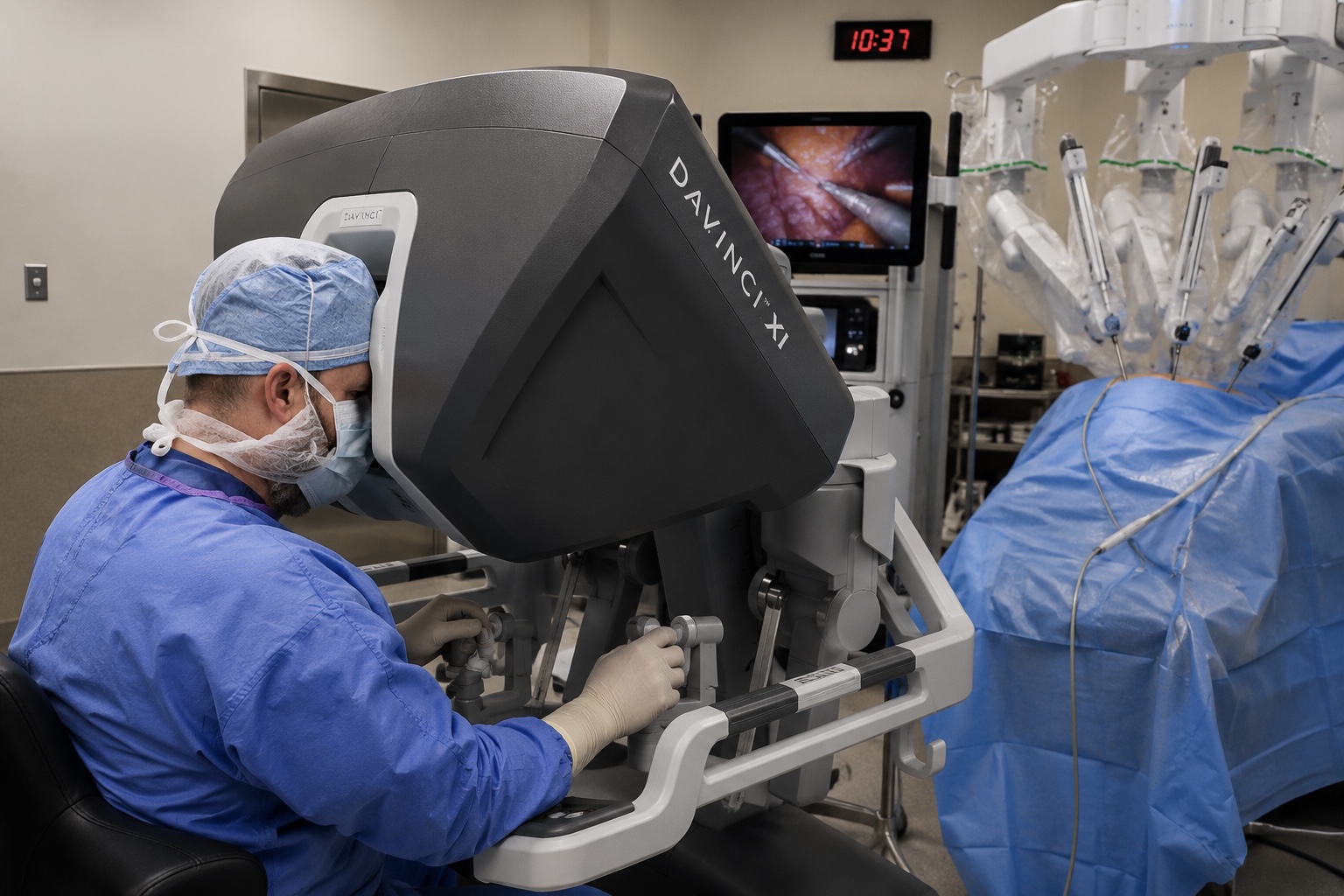
Dr. Daniel Gay provides robotic, laparoscopic, and open hernia repair with an approach selected for your anatomy, diagnosis, prior surgery, and goals—not simply the newest technology.
Both are minimally invasive approaches performed through small incisions using a camera and long instruments. Both can reduce the size of the surgical incision compared with selected open operations.
Several small access points replace a larger incision for selected hernia repairs.
A camera gives the surgeon a detailed view of the hernia and surrounding anatomy.
Robotic and laparoscopic repairs are generally performed while the patient is asleep.
Mesh may be positioned inside or outside the abdominal cavity depending on the operation.
The hernia opening may be closed before reinforcement when appropriate.
Pain, activity, and return-to-work plans depend on the repair, not only the access method.
The robotic platform can expand what a surgeon is able to accomplish through small incisions. These are technical benefits; whether they improve a particular patient’s outcome depends on the hernia and procedure.
Robotic instruments articulate inside the body, which can make suturing and working at difficult angles more manageable.
A magnified, high-definition 3D view can improve depth perception during precise dissection and reconstruction.
The platform may facilitate closing hernia defects, rebuilding tissue layers, and securing mesh.
Selected preperitoneal, retrorectus, TAPP, and eTEP repairs may be performed minimally invasively.
Some repairs that might otherwise require a larger open incision may be candidates for a robotic approach.
The seated console and instrument control may reduce surgeon strain during lengthy, technically demanding operations.
| Approach | Strengths | Considerations |
|---|---|---|
| Robotic | Wristed instruments, 3D visualization, advanced suturing, and access to selected extraperitoneal mesh planes. | Often longer operative time; availability and cost can differ; not proven superior for every repair. |
| Laparoscopic | Established minimally invasive approach with small incisions and efficient repair for selected hernias. | Straight instruments can make complex suturing and certain tissue-plane repairs more technically demanding. |
| Open | Direct access, flexibility, and an important role in small, large, emergency, recurrent, or complex repairs. | May require a larger incision depending on the operation and anatomy. |
Technology is a tool, not the goal. Dr. Gay discusses why a particular approach fits your hernia and the meaningful tradeoffs before surgery.
Small incisions allow placement of a camera and surgical instruments.
The hernia contents are reduced and the repair plane is prepared.
The defect may be closed and reinforced with an individualized mesh plan.
Patients receive a personalized pain-control and activity plan.
Comparative evidence is still evolving. Studies generally support robotic hernia repair as a safe option, but they do not show that it is automatically better for every patient or every hernia.
Robotic repair may enable more advanced minimally invasive techniques. For many standard repairs, clinical outcomes are similar to laparoscopy, while robotic operations often take longer and may cost more. Procedure selection and surgeon experience remain important.
No clear differences in wound complications, recurrence, readmission, or patient-reported outcomes; robotic repair was considered safe compared with laparoscopy.
PubMed PMID 33630447Robotic repair showed similar or potentially improved outcomes, but authors called for larger trials and longer follow-up.
PubMed PMID 37203558Pain was similar at one year; HerQLes quality-of-life improvement favored robotic repair in this exploratory analysis.
PubMed PMID 35703814Robotic and laparoscopic approaches had similar safety and postoperative outcomes; robotic unilateral repair took longer and costs were higher.
PubMed PMID 34609697Robotic repair may be useful for selected inguinal, ventral, umbilical, incisional, and recurrent hernias. It can be especially helpful when precise suturing or work in a preperitoneal or retrorectus plane is planned.
Open surgery may still be the safer or more effective choice for some emergency, very large, infected, recurrent, or anatomically complex hernias.
Patient-reported outcomes help measure pain, function, confidence, and quality of life after hernia repair. Quality improvement initiatives help surgeons compare approaches and refine evidence-based care.
Review practical information about hernia surgery and recovery before your consultation.
Robotic hernia repair is minimally invasive surgery performed through small incisions using a surgeon-controlled robotic platform with wristed instruments and three-dimensional visualization.
No. The surgeon controls every instrument movement. The robotic platform does not operate independently.
Potential technical benefits include wristed instruments, three-dimensional visualization, precise suturing, and the ability to perform selected complex repairs minimally invasively.
Not for every patient. Evidence generally shows similar safety and patient outcomes for many repairs, while robotic surgery may offer technical advantages for selected procedures and often requires more operative time.
No. Hernia anatomy, prior surgery, emergency findings, complexity, and patient health may make an open repair preferable.
Recovery varies by hernia and procedure. Many patients resume light daily activity within days and gradually return to more demanding work and exercise.
Meet directly with Dr. Gay to understand whether robotic, laparoscopic, or open repair best fits your diagnosis and goals.
Watch this brief overview, then bring your questions to your visit.
This guide supports an informed conversation with a surgeon. Recommendations must be individualized after examination and review of relevant records.
Robotic and laparoscopic platforms use small ports and magnified internal visualization; robotic instruments add wristed articulation.
These platforms can facilitate suturing and dissection in preperitoneal or retrorectus planes for selected hernias.
Anatomy, defect size, prior surgery, health, and surgeon experience determine suitability.
A hernia does not usually heal with medication. Nonsurgical management can include watchful waiting for selected minimally symptomatic patients, activity modification, treatment of cough or constipation, smoking cessation, nutrition, glucose control, and weight or fitness optimization before surgery.
Robotic techniques may include TAPP, eTEP, retrorectus repair, and selected component separation; conversion or open repair may still be needed.
Repair risks include bleeding, infection, seroma, urinary retention, injury to bowel, bladder, vessels, nerves, or spermatic structures, chronic pain, numbness, mesh-related complications, recurrence, conversion to open surgery, and anesthesia complications. Risk varies substantially by anatomy and prior operations.
Recovery depends on the exact procedure, disease severity, health, work demands, and whether additional treatment is needed. Before treatment, discuss expected pain control, wound care, activity, diet, pathology results, follow-up, and the symptoms that should prompt a call.
Urgent care: Call 911 or seek prompt evaluation for severe or rapidly worsening pain, heavy bleeding, trouble breathing, repeated vomiting, fainting, rapidly spreading redness, or another emergency.
Bring relevant imaging, pathology, laboratory results, medication lists, prior operative reports, and your questions when available.